

TRAIN at 100 Yards • SHOOT to 1000 Yards™





Before we begin to talk about DOPE, we want to make sure that new shooter understands one fundamental concept and that is the impact point at the zero distance versus any other distance.
Once a bullet leaves the barrel, it begins to drop due to gravity pulling down on it. The amount of drop is fundamentally due to the time that gravity is acting on the bullet, also known as the time-of-flight. When you zero your rifle at 100 yards, it means that at 100 yards, where you put the crosshair on the bullseye is where the bullet will impact because you have compensated for the time of flight and hence the gravity drop at 100 yards. A new shooter might be led to believe that they can put their crosshair on a bullseye placed at 300 yards and the impact will still be in the center of the bullseye. That is incorrect since the bullet is in the air longer and continues to drop due to gravity during the additional time-of-flight. This is why knowing your muzzle velocity is so important. The shorter the time the bullet is in the air, the less the bullet drop due to gravity (time).
Dialing your elevation turret on your scope to compensate for the additional drop is how you can continue to hold the crosshairs on target, even at distance. The values you need to dial comes from your own DOPE card, developed by you, using the ammo manufacturers information, rifle information, and a free ballistic calculator app.
For the purposes of the Long-Distance Training Solution, we give you a target that simulates multiple "steel plates" at varying distances. In order to hit those “plates”, you consult the matching DOPE card that we provide which represents the bullseyes location on the paper. You dial in the solution for the target you wish to impact, then hold your crosshairs on the REFERENCE bullseye and fire. The correct scope adjustments will adjust the trajectory of your shot to impact your intended bullseye.
This is the introduction to the use of a DOPE card or ballistic calculator. We have developed a DOPE card which corresponds specifically to this target with the bullseyes offset to the aiming (REFERENCE) point of R0 and B0.
Here is an example of how you develop your skills:
Let’s imagine that you are working with the red bullseye designated R4. The REFERENCE bullseye for all the red targets is R0. That is where you will AIM. If you consult the included DOPE card (in this example we will be using the MIL target and matching DOPE), you will see that the simulated yardage for R4 is 725 yards, and the Elevation value is 4.90. If you dial your scope’s Elevation turret to 4.9 MIL, and AIM at the R0 Reference, and fire, you will hit the R4 target.
In the real world, if you were on a range where there was a target at 725 yards, and you had your own DOPE card based on your ammo and rifle configuration, your DOPE might tell you to dial 5.2 MIL. Assuming perfect environmental conditions, if you dial 5.2 MIL and put the crosshair on the actual target, you will hit it, assuming your DOPE is accurate.
DEVELOPING YOUR OWN DOPE:
As we discuss developing your DOPE, we will be referencing the Hornady Ballistic Calculator. We will not be attempting to teach you how to use the app, as every app is different, but each app has the same fundamental settings that you will learn to use.
RIFLE:
Your rifle has 3 important variables that you will need:
-
Barrel Length
-
Twist Rate
-
Scope Height
Barrel Length: Generally speaking, the longer the barrel, the more velocity you will have because the powder burn will have more time to propel the projectile down the barrel, utilizing pressure buildup to increase velocity.
Twist Rate: Each barrel is manufactured with a certain twist rate like 1:8 – this example means that the bullet will rotate as it travels down the barrel at a rate of 1 revolution every 8 inches. Additionally, the twist can be LEFT or RIGHT but most common rifles are right twist. This direction will affect another variable called SPIN DRIFT, but that is outside the scope of this fundamental conversation.
Scope Height: This is the measurement between the center of the chamber and the center of the scope.
AMMUNITION:
The ammo that you use has the most variables, and like anything else, the better the ammo, the most consistent your groupings will be. The variables you will need are:
-
Muzzle Velocity
-
Barrel length associated with Muzzle Velocity (optional)
-
Ballistic Coefficient (BC)
-
Weight
-
Overall Length (optional)
Muzzle Velocity: This is an approximation that you will enter in the calculator, but as you develop your skills, you will find that you will want to purchase your own chronograph and determine the actual velocities your rifle is producing. But use the manufacturer’s velocities to get you started, even if they used a different barrel length to calculate the factory muzzle velocity.
Barrel Length (optional): Generally, the manufacturer will use a long barrel length to achieve the highest velocities they can to make their ammo seem better that it will be in a shorter barrel rifle. Again, use the manufacturer’s information to begin, and tweak later.
Ballistic Coefficient: This spec is basically a measure of the efficiency of how well the bullet travels over distance. The better (or higher) the number, the flatter the trajectory of that projectile, and the more efficiently it will be able to handle the effects of gravity and wind. BC data comes in two flavors – G7 and G1. Ballistic Calculators will allow you to use either, but you may want to read up on the differences, and which is the better one to use based on specific bullet.
Weight: The weight (in GRAINS) of the projectile.
Bullet Length (optional): Some calculators offer a place to enter this data. Every little bit of data helps the accuracy of your calculator, so if it has a place, enter the data.
For now, we will input those data points into a ballistic calculator. These calculators can be found online for free, or free downloadable apps for your smart phones. Some allow you to export tables so you can print your ballistics table or DOPE card. Some popular apps include Hornady, Applied Ballistics, and Athlon.
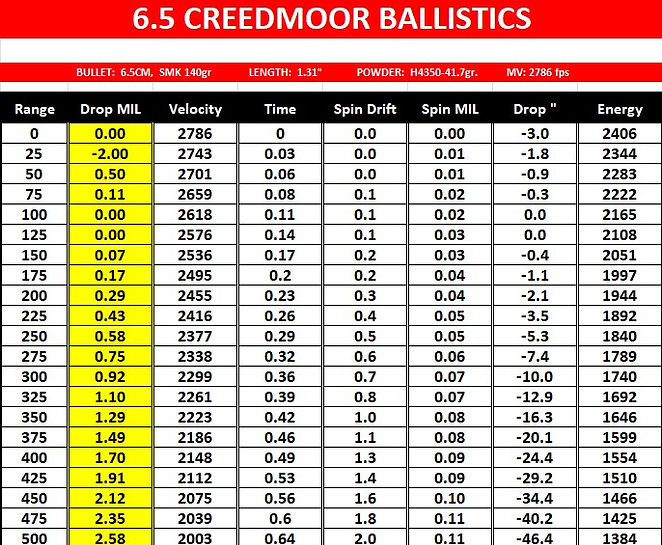
Here is a sample of a ballistic table and the associated readout from the Hornady 4DOF® Ballistic Calculator for 375 yards.
Printed DOPE Card
vs.
Hornady Ballistic Calculator

As you can see, there is more information in a typical DOPE card than we use for our target. But remember, we are attempting to keep things fundamental for learning purposes.
This table continues according to my settings. You could develop a table that increments every 100 yards, or every 50 yards. Each yardage will tell you how much to dial your scope in order to put the crosshairs on target for an accurate impact at that distance.
This is an invaluable tool to help you QUICKLY acquire the proper settings for your scope to fire and hit targets at known ranges. Most apps will allow you to type or dial a yardage, estimate a wind speed and direction, and it will give you your firing solution in elevation and windage.
Will you need to develop your own DOPE in order to use this system accurately?
No.
We developed a matching DOPE card that provides the necessary information for every bullseye on this target. Since this is a SIMULATION of long-range shooting, we also simulate the DOPE values you have to use in order to make it work at 100 yards. However, when you get to a real long range, you will need to have developed your own DOPE as described above. For now, let’s move on to the DOPE card which is shown below. You can click on the MIL or MOA card to enlarge the card. You can also click on the DOWNLOAD MIL DOPE or DOWNLOAD MOA DOPE buttons to download the cards.

